BURNHAM YARD
A Unique, Industrial Historic Site — Now the Preferred Site for a New Denver Broncos Stadium
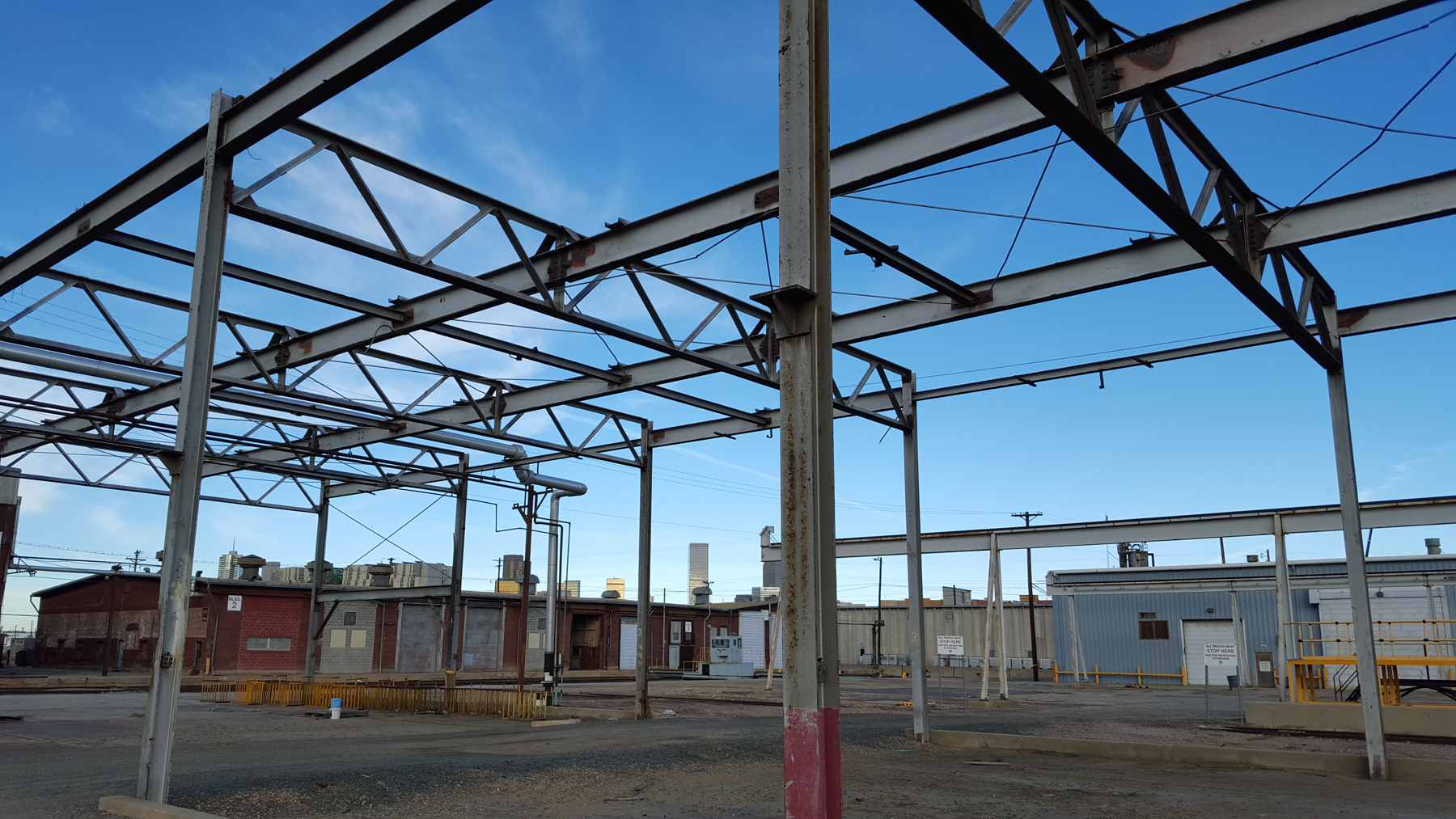
Burnham Yard, the former rail yard situated in an industrial corridor near the South Platte River and I-25, has moved from an uncertain future to the center of one of Denver’s most significant development stories in decades: it is now the Denver Broncos’ preferred site for a new stadium and surrounding mixed-use neighborhood.
On August 4, 2026, the Broncos released updated master plan renderings for the roughly 100-acre district surrounding the stadium site. Sasaki did the initial planning work and infrastructure master plan, presented to the community in February 2026; Denver-based Tryba Architects has since taken over master planning and design for the district. Separately, the stadium itself is being designed by Manica Architecture, a firm with a track record of NFL stadium projects. No stadium renderings have been released yet — team president Damani Leech has said those are still a ways off as approvals and negotiations continue, and by his own account, not without some friction between team officials and community coalitions. The project overall is targeted to open by 2031, when the team’s lease at Empower Field at Mile High expires.
WHY IT MATTERS
“The Burnham Yards” operated as one of the city’s most significant rail yards for more than 150 years — first as the primary facility for the Denver & Rio Grande Railroad (D&RG), and much later for Union Pacific, which acquired the D&RG. The use of the yards predates Colorado statehood.
Union Pacific closed Burnham in 2016, and in 2021 the Colorado Department of Transportation (CDOT) purchased the land, originally citing potential future needs like I-25 expansion and passenger or light rail. That land is now the site of the Broncos’ planned stadium and surrounding entertainment district.
HISTORY OF THE SITE
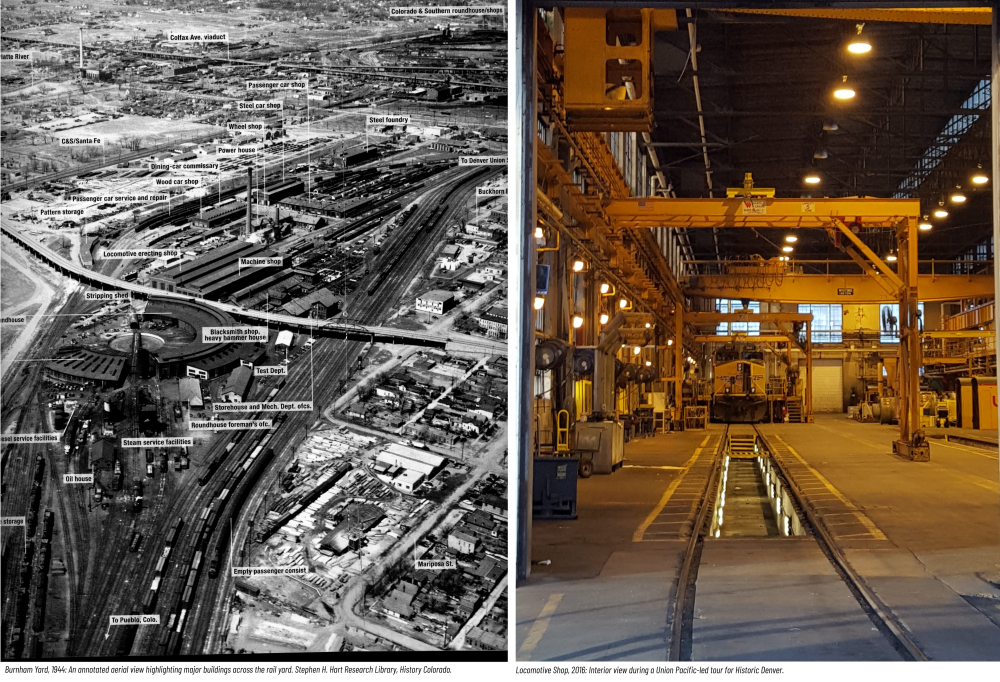
Burnham Yard traces back to 1871, when General William Jackson Palmer founded the Denver & Rio Grande Railroad and built a shop site two miles south of downtown Denver to service its first locomotives — engines ordered from Philadelphia’s Baldwin Locomotive Works and named, according to the delivering engineer’s own account, for Baldwin executive George Burnham. For the next 145 years, Burnham Shops remained the D&RG’s — and later the Denver & Rio Grande Western’s — primary repair and maintenance facility, building and rebuilding the locomotives, freight cars, and passenger equipment that ran across Colorado and beyond. By 1901 that growth had produced the brick Coach Shop — with evidence it may have incorporated an even older 1880s structure — the oldest building on the site. At its peak, the yard employed as many as 2,000 workers, drawn largely from Hunt’s Addition and Sumner’s Addition, the working-class subdivisions built up around it that are now part of La Alma Lincoln Park and Baker.
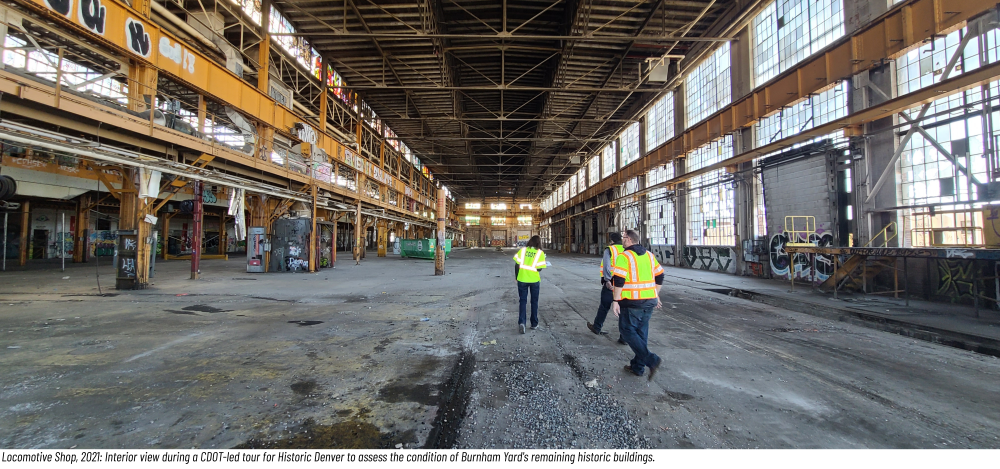
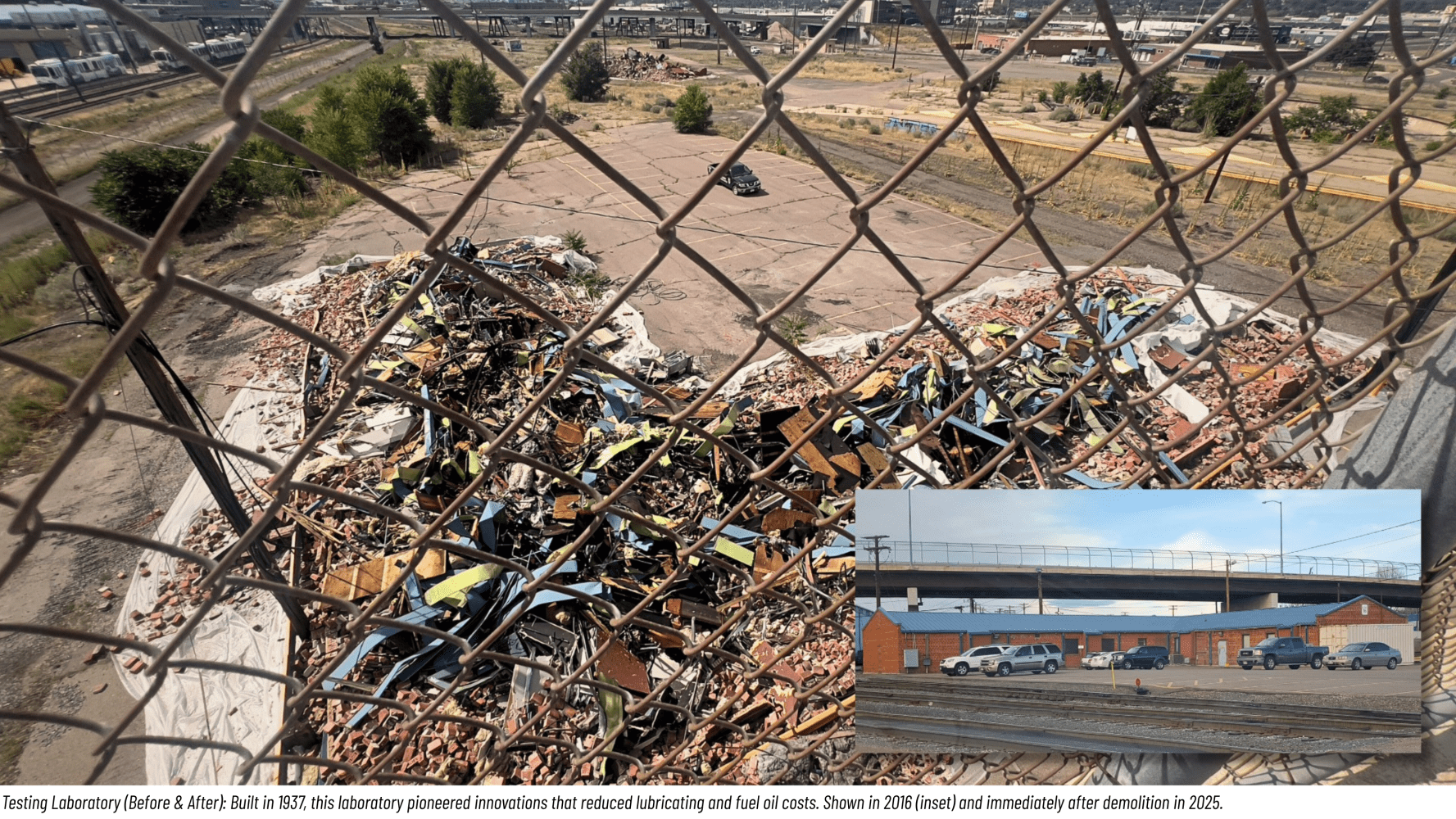
That growth peaked with a second and more dramatic rebuilding between 1924 and 1926, when the railroad, freshly stabilized after years of financial trouble, replaced its aging shops with a modern complex sized for larger, heavier equipment. The centerpiece was the huge brick Locomotive Shop — also called the Backshop — 168 feet wide and 436 feet long, built alongside the new Steel Car Shop. A Testing Laboratory followed in 1937, developing fuel and lubricant savings that saved the railroad hundreds of thousands of dollars a year, and a larger turntable arrived in 1940 as the yard began its shift from steam to diesel power.
World War II reshaped the workforce as much as the buildings. With men gone to war, the D&RGW hired large numbers of women into mechanical and scientific roles and built a dedicated Women’s Locker Room in 1943 to house them. A year later, the railroad added a wing to the Roundhouse Foreman’s Office built specifically for its Black workforce — reflecting the segregation those employees navigated even as their numbers grew during the war.
The railroad changed hands twice more — folding into Southern Pacific in 1988, then Union Pacific in 1996 — before Burnham Shops finally closed in February 2016, ending 145 years of continuous operation. The following year, a historic resources research report examined the newly vacant property and recommended six buildings and three structures for preservation — the first attempt to document what stood there before further losses. Then, in 2021, a fire severely damaged the 1901 Coach Shop.
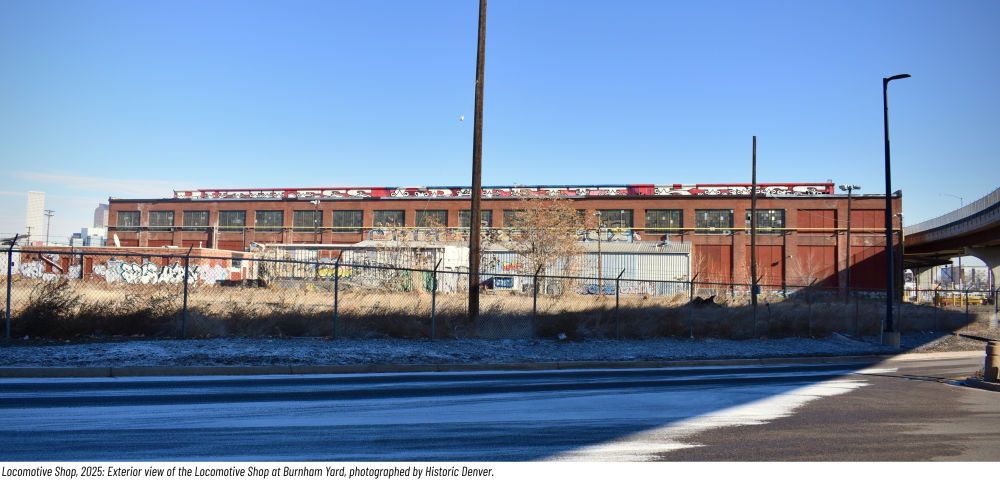
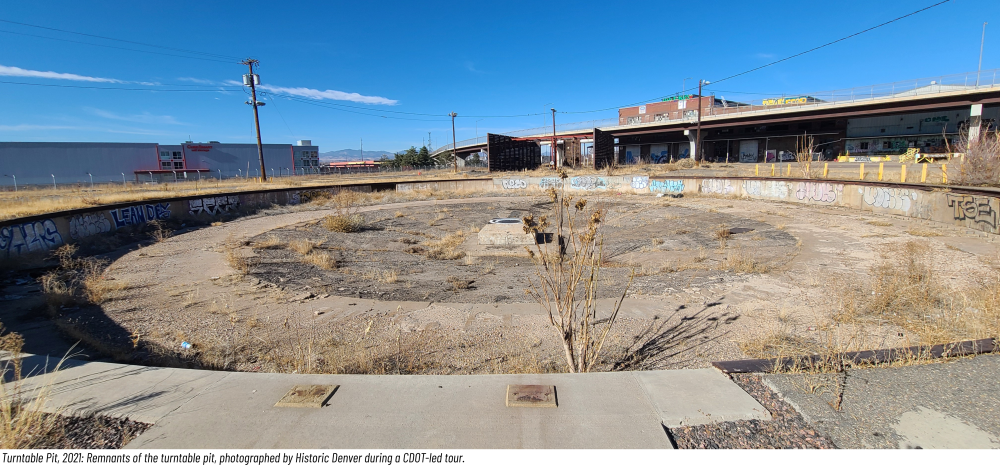
In 2024, CDOT commissioned its own historic resources survey, examining every building, structure, and slab remaining on the property at that time. That study identified ten individually eligible historic resources: five buildings — the Locomotive Shop, Women’s Locker Room, Roundhouse Foreman’s Office, Testing Laboratory, and Steel Car Shop — four structures, including the turntable pit and the transfer table pit, and the fire-damaged remains of the 1901 Coach Shop.
Only two of those ten exist today: the Locomotive Shop and the turntable pit. Everything else the 2024 survey documented is gone. CDOT demolished four of the five eligible buildings in 2025 — the Women’s Locker Room, the Roundhouse Foreman’s Office, the Testing Laboratory, and the Steel Car Shop. What survives is what the site’s next chapter gets built around.
WHAT’S PRESERVED IN THE CURRENT PLAN
The Locomotive Shop is the only historic building to survive into the current master plan, a 1924 structure and the largest remaining building on site. It sits along a reimagined, slower, “Main Street”-feeling 8th Avenue in the district the Broncos call “Village Center,” and the team has floated the shop itself becoming some kind of market or open food hall.
The historic railroad turntable pit, just south of the Locomotive Shop, will also be retained and reimagined as the centerpiece of the “Turntable” district’s green space — something the Broncos have said since early on they wanted to preserve as a neighborhood landmark.
The former freight rail corridor will become the “Mile High Line,” a tree-lined trail for walking, biking, and running. The city has expressed interest in extending it to connect with Santa Fe Yards and Ball Arena. The updated plan calls for roughly 11-12 acres of new public open space, usable year-round.
Other changes in the updated plan include eliminating the 11th Avenue rail crossing (for pedestrian and bike safety), a substantially expanded RTD light rail stop at 10th Avenue and Osage Street, and extending some of Burnham Yard’s historic street grid through the site.
The master plan is organized into four districts: North End, Village Center, Turntable, and South End.
HISTORIC DENVER’S ROLE
Historic Denver’s involvement with Burnham Yard goes back more than a decade, to when Union Pacific first announced it would be leaving the site. We engaged early, touring the buildings ourselves to understand their condition and potential. A 2017 research report by Square Moon Consultants identified six buildings and three structures as historically significant. After CDOT purchased the property in 2021, we returned to the site, shared our findings with the agency, and pointed out the potential for a historic district among Burnham Yard’s surviving buildings. We met with CDOT once more in early 2025 to make a final case for retaining the structures and leaving the question of how to integrate them to whatever owner came next. The state ultimately recommended retaining fewer historic resources than Historic Denver had suggested, and four buildings were demolished in 2025.
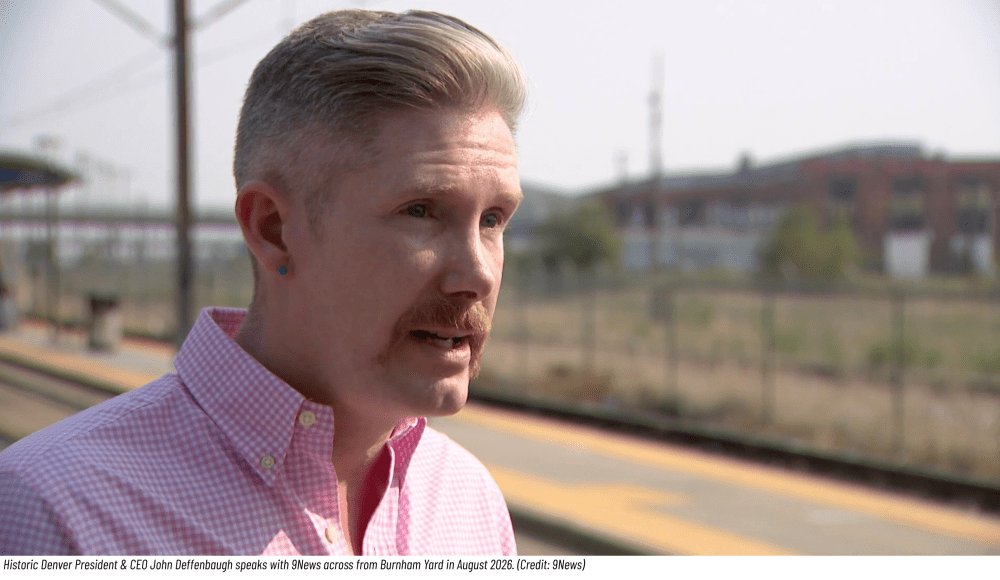
Since then, our focus has shifted to making sure the two structures that remain — the Locomotive Shop and the turntable pit — are thoughtfully incorporated into whatever comes next for the site. Our President and CEO, John Deffenbaugh, currently sits on the Small Area Plan Community Advisory Committee and is working alongside neighboring communities on a community benefits agreement, in coordination with the site’s new owners. “With vision, older buildings and new development can go hand-in-hand,” Deffenbaugh has said, pointing to Coors Field — itself inspired by the historic-building integration at Baltimore’s Camden Yards — as proof it’s been done before. Earlier this year, we researched stadium-anchored districts across North America and Europe and found that the most enduring projects “weave historic places into new development, strengthen the neighborhoods around them, and ensure that the benefits of redevelopment extend well beyond the stadium itself.”
Historic Denver is a community-led organization, and nowhere is that more relevant right now than at Burnham Yard. The future stadium site borders La Alma Lincoln Park, Sun Valley, and Baker — neighborhoods whose residents helped build the railyard generations ago and that Deffenbaugh has named among the most at risk of gentrification and displacement as the project moves forward. Getting this right will take sustained attention to the people who live nearest the site, not just the design itself. Our job is to advocate on behalf of Denverites for the places and spaces that matter to them — and to remember that, as Deffenbaugh has put it, “history does not end at the property line.”
GET INVOLVED
Historic Denver’s work on sites like Burnham Yard is powered by our Supporter Program. Becoming a supporter provides the financial backing that lets our staff advocate for historic places every day, and shows the community — and the decision-makers shaping Burnham Yard’s future — that people care.
LEARN MORE
Denver Gazette: Broncos tease vision of mixed-use attractions that would wrap Burnham Yard
Denver Post: Broncos’ updated Burnham Yard district renderings
Denver7 – Buildings demolished at Burnham Yard amid speculation about future DenverBroncos stadium
Mile High CRE – Historic Properties at CDOT’s Burnham Yard Demolished
Westword – As Broncos Look to the Future, Historic Denver Looks to the Past of BurnhamYard